

BEIJING, Dec. 23 (Xinhua) -- From orchestrating a groundbreaking in-orbit emergency rescue to launching its first asteroid mission and making a wealth of breakthroughs in frontier science, China's 2025 space endeavors have mapped out new dimensions for cosmic exploration.
China's space station operations have had a sustained human presence this year, beginning with the launch of the Shenzhou-20 crewed spacecraft on April 24, which brought astronauts Chen Dong, Chen Zhongrui and Wang Jie to the orbiting station for a planned six-month mission. The Shenzhou-19 crew then concluded their mission and returned to Earth with the results of fruitful experiments.
Prior to Shenzhou-20's scheduled return on Nov. 5, the spacecraft was found to have developed tiny cracks in the viewport window of its return capsule, which were most likely caused by external impact from space debris. This rendered it unsuitable for a safe crew return.
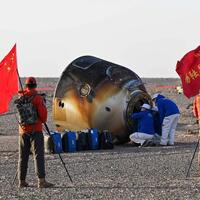
In a demonstration of operational flexibility and safety-first design, China executed two critical, novel procedures. First, the Shenzhou-20 crew safely returned to Earth on Nov. 14 aboard the Shenzhou-21 spacecraft, which had been launched on Oct. 31 with a new trio of astronauts -- Zhang Lu, Wu Fei, and Zhang Hongzhang. This marked the first successful implementation of an alternative return procedure in the history of the country's space station program.
Second, to ensure the new Shenzhou-21 crew had a dedicated return vehicle, China undertook an emergency launch. On Nov. 25, the uncrewed Shenzhou-22 spacecraft blasted off from Earth, carrying crucial supplies, including devices to repair Shenzhou-20's window, and securing the continuous safety of astronauts on the station. This first-ever emergency crew-backup launch underscored the program's growing maturity and contingency response capabilities.
This year has also seen progress in international space cooperation, with China and Pakistan signing an agreement in February on selecting and training Pakistani astronauts for future space station missions, highlighting China's commitment to partnering with developing nations in the field of crewed spaceflight.
China's deep space endeavors have advanced significantly in 2025. On May 29, the Tianwen-2 probe was launched successfully, embarking on the country's first asteroid exploration and sample-return mission.
With a designed cycle of approximately 10 years, the mission aims to explore and sample the 2016HO3 asteroid and return the samples to Earth, followed by an exploration of the 311P main-belt comet.
It focuses on measuring the physical parameters of its two celestial targets, including their orbital dynamics, rotation, size, shape and thermal properties.
The mission will also investigate the topography, composition and internal structure of the two celestial bodies, and will potentially study the materials ejected by the main-belt comet.
This pioneering journey is expected to advance our understanding of the origins, evolution and characteristics of these two types of small celestial bodies.